
The story behind 1.5°C: Why Did We Decide on This Number?
How scientific consensus and international treaty obligations turned a half-degree temperature target into the world's foundational climate benchmark.
14 November 2026
Science
The half-degree difference at a glance
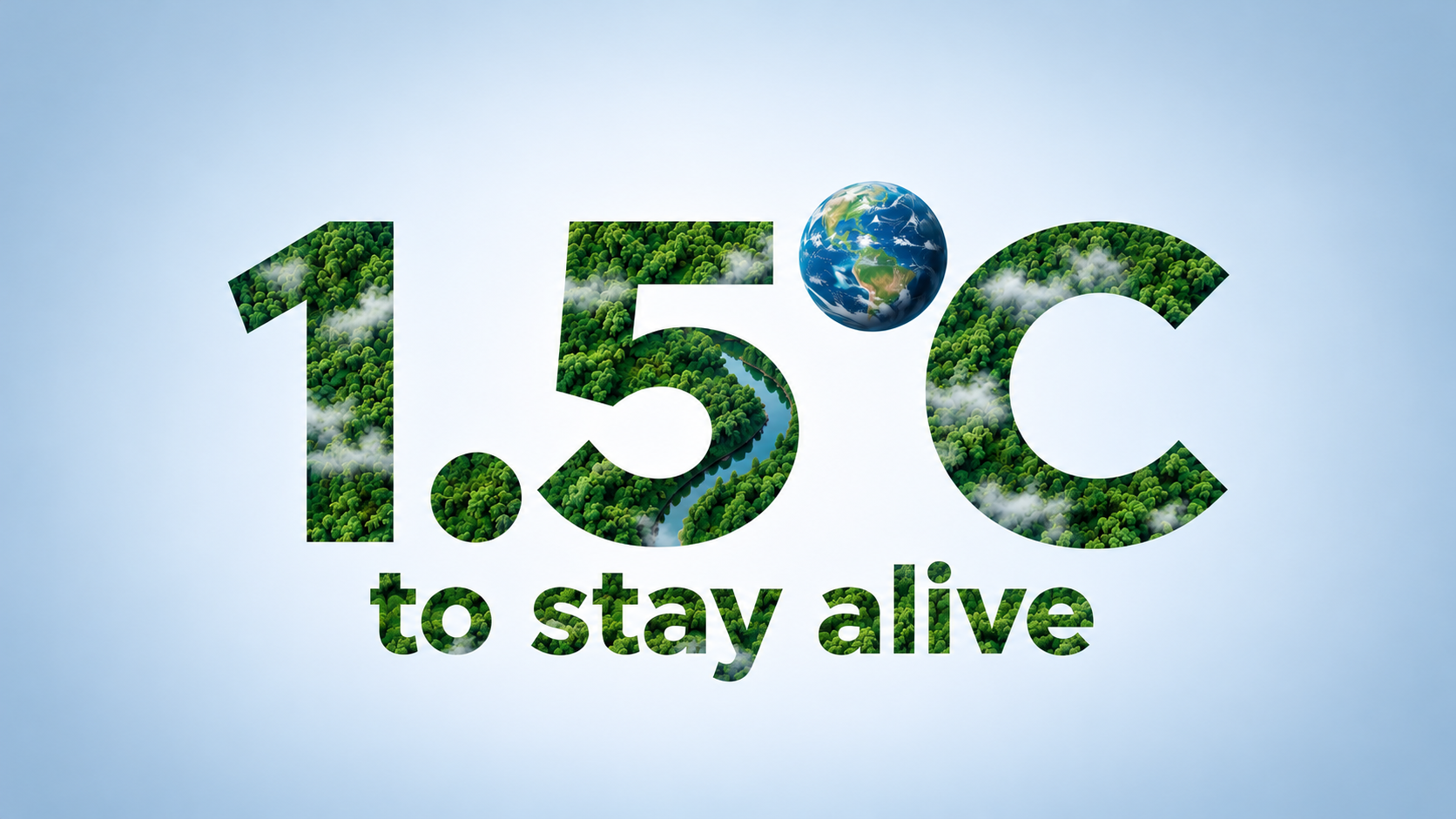
• 1.5°C is a physical scientific boundary, not only a political preference.
• Exceeding 1.5°C drastically escalates extreme heat exposure, permafrost loss, ocean acidification, and irreversible ecosystem collapse.
• Holding warming to 1.5°C yields substantial global financial benefits, preventing an additional 5% drag on global per capita GDP by 2100 compared to 2.0°C.
For over three decades, the global climate debate revolved around avoiding "dangerous anthropogenic interference" with the Earth's climate system, as enshrined in Article 2 of the 1992 United Nations Framework Convention on Climate Change (UNFCCC).[1] Initially, international negotiations consolidated around a 2°C global warming limit. However, for developing nations, small island developing states (SIDS), and coastal communities, 2°C of global warming was not a safe guardrail rather represented an existential threat.[2]
The push for a tighter 1.5°C limit gained formal diplomatic momentum at COP16 in Cancun (2010), which established a Structured Expert Dialogue (SED) between 2013 and 2015 to review the adequacy of the long-term global goal. The SED concluded that 2°C could no longer be regarded as a safe 'guardrail' and recommended re-framing temperature limits as a 'defence line' to be kept as low as possible.[3] This scientific and political shift culminated at COP21 in 2015, where 195 nations adopted the landmark Paris Agreement, committing under Article 2(1)(a) to hold global average temperature increase to "well below 2°C above pre-industrial levels and pursuing efforts to limit the temperature increase to 1.5°C."[4]
The Science
To understand why 1.5°C became the defining numerical target, we must look through the climate science codified in the Intergovernmental Panel on Climate Change (IPCC) reports, notably the Special Report on 1.5°C (SR15) and the Sixth Assessment Report (AR6). The IPCC established that human activities have unequivocally caused global warming, reaching approximately 1.1°C (1.09°C [0.95°C to 1.20°C]) above pre-industrial levels (1850–1900) in the decade 2011–2020.[5] Greenhouse gas emissions primarily carbon dioxide (~0.8°C contribution) and methane (~0.5°C contribution) are the primary drivers.
A foundational scientific insight underpinning the 1.5°C target is the near-linear relationship between cumulative anthropogenic CO2 emissions and global temperature rise. This linear relationship gives rise to the concept of the global carbon budget: the finite aggregate amount of CO2 humanity can emit before crossing a given temperature limit. According to IPCC AR6 estimates, starting from the beginning of 2020:[5][6]
• 50% Likelihood of Limiting Warming to 1.5°C: Requires limiting remaining cumulative CO2 emissions to 500 GtCO2 (which is depleted in roughly 10–11 years from 2020 at current global emission rates of ~40 GtCO2/year).[6]
• 83% Likelihood of Limiting Warming to 1.5°C: Reduces the remaining budget to just 300 GtCO2, requiring net-zero emissions globally by 2027 i.e. a timeline nearly exhausted under current trajectory.[6]
• 2.0°C Carbon Budget (50% vs 83% Likelihood): Allows 1,350 GtCO2 (50% probability, ~32 years at current rates) or 900 GtCO2 (83% probability, ~21 years at current rates).[6]
Beyond carbon budgets, climate science emphasizes the non-linear risk of triggering critical 'tipping points' thresholds where elements of the Earth system undergo self-perpetuating, abrupt, and irreversible changes. Synthesis studies demonstrate that current global warming (~1.1°C) already lies within the uncertainty range for several tipping points. Crossing 1.5°C significantly increases the probability of triggering core tipping elements, including the collapse of the Greenland and West Antarctic ice sheets, irreversible loss of tropical coral reefs, and widespread thawing of Boreal permafrost.[7]
Scenarios and What Happens Under Different Pathways
The IPCC report models global emissions pathways using Shared Socioeconomic Pathways (SSPs) to illustrate how the Earth system responds under different mitigation choices. Pathways categorized in IPCC AR6 reveal the stark structural differences between 1.5°C and higher warming futures:[10]
• Category C1 (Limit warming to 1.5°C with no or limited overshoot): Greenhouse gas emissions must peak immediately (between 2020 and 2025 at the latest), falling by 43% by 2030 and 84% by 2050 relative to 2019 levels, achieving global net-zero CO2 around 2050.[10]
• Category C2 (Return warming to 1.5°C after a high overshoot): Global temperature exceeds 1.5°C by 0.1°C–0.3°C for several decades before returning. This pathway relies heavily on speculative, unproven large-scale Carbon Dioxide Removal (CDR) technologies, introducing severe ecological, land-use, and social risks.[5][10]
• Category C3 (Limit warming to 2.0°C with >67% likelihood): GHG emissions decline by 27% by 2030 and 63% by 2050, reaching net-zero CO2 around 2070–2075.[10]
The physical and socioeconomic differences between a 1.5°C world and a 2.0°C world demonstrate that half a degree of warming represents a profound divergence in global risk:[8]
Extreme Heat Exposure — 1.5°C Global Warming Future: 14% of global population exposed to severe heat waves at least once every 5 years. | 2.0°C Global Warming Future: 37% of global population exposed to severe heat waves (a 2.6x increase).
Arctic Sea Ice — 1.5°C Global Warming Future: 1 sea-ice-free Arctic summer projected per 100 years. | 2.0°C Global Warming Future: 1 sea-ice-free Arctic summer projected every 10 years (a 10x increase).
Sea Level Rise & Flooding — 1.5°C Global Warming Future: 0.40m rise by 2100; ~69 million people exposed to coastal flooding risks. | 2.0°C Global Warming Future: 0.46m rise by 2100; ~79 million people exposed to coastal flooding risks.
Permafrost Degradation — 1.5°C Global Warming Future: 21%–37% of Arctic permafrost thaws by 2100 (~4.8 million km²). | 2.0°C Global Warming Future: 35%–47% of Arctic permafrost thaws by 2100 (area 3/4 the size of Australia).
Ecosystem & Biome Shift — 1.5°C Global Warming Future: 4% of global land area undergoes biome shifts (e.g., tundra to forest). | 2.0°C Global Warming Future: 13% of global land area undergoes biome shifts (a 3x increase).
Global GDP Per Capita — 1.5°C Global Warming Future: Median GDP per capita 8% lower in 2100 compared to no additional warming. | 2.0°C Global Warming Future: Median GDP per capita 13% lower in 2100 (a 5% further economic drag).
Incorporating 1.5°C into The Paris Agreement
While science establishes 1.5°C as a vital geophysical boundary, legal scholars and international tribunals have examined how this number functions as a legal standard. Under Article 2(1)(a) of the Paris Agreement, state parties agreed to pursue efforts to limit temperature rise to 1.5°C. For years, legal commentators debated whether Article 2 represented a mere aspirational political goal or created binding legal duties.[13]
Subsequent state practice, decisions by the Conference of the Parties serving as the meeting of the Parties to the Paris Agreement (CMA) notably Decision 1/CMA.3 (Glasgow Climate Pact) and Decision 1/CMA.4 (Sharm el-Sheikh) and authoritative judicial rulings have formally elevated 1.5°C as the primary reference goal under Article 31(3)(a) of the Vienna Convention on the Law of Treaties (VCLT). In its milestone 2025 Advisory Opinion on Climate Change, the International Court of Justice (ICJ) affirmed that 1.5°C is the agreed primary temperature goal under the Paris Agreement, reflecting the scientific consensus required to base climate action on the best available science.[12][13]
From an international law perspective, Article 2(1)(a) expresses the object and purpose (ratio legis) of the Paris Agreement. Drawing from Articles 18 and 26 of the VCLT, state parties possess an individual and integral obligation of due diligence to refrain from acts that would defeat this collective temperature goal.[13]
This obligation establishes:
1. Stringent Standard of Conduct ('Do the Utmost'): Due diligence in climate mitigation is non-binary and evolving, requiring states to exercise their 'highest possible ambition' (Article 4(3)) and do their utmost using available resources and capabilities.[12][13]
2. Erga Omnes Partes Character: Safeguarding the climate system is a common concern of humankind. Consequently, the duty not to defeat the 1.5°C goal is owed erga omnes partes meaning every state party has a legal interest in enforcing compliance against counterparts that fail to meet their due diligence standard.[12][13]
3. NDC Alignment Mandate: Nationally Determined Contributions (NDCs) submitted under Article 4 cannot be set at a state's arbitrary discretion; they must be capable of making an adequate contribution toward remaining within the 1.5°C carbon budget.[12][13]
Why It Matters
In sum, 1.5°C is an absolute physical constraint backed by strict carbon accounting. Every tenth of a degree of warming avoided preserves human lives, agricultural yields, coastal infrastructure, and macroeconomic stability.
For businesses and financial markets, the operationalization of 1.5°C into legal due diligence signals an era of heightened liability. General corporate claims of 'carbon neutrality' based on unverified, off-grid nature-based offsets are facing intense regulatory scrutiny and judicial challenges. Courts increasingly treat international 1.5°C science as the benchmark against which corporate climate claims and state regulatory oversight are measured.
For legal practitioners and scholars, the synthesis of climate science and treaty law establishes that state obligations under the Paris Agreement are not self-contained aspirations. They interact with customary obligations to prevent significant transboundary harm, human rights law, and international due diligence standards.
Citations (in order of appearance)
1. United Nations Framework Convention on Climate Change (UNFCCC) (adopted 9 May 1992, entered into force 21 March 1994) 1771 UNTS 107, art 2.
2. UNFCCC, Report on the Structured Expert Dialogue on the 2013–15 Review: Note by the Co-Facilitators of the Structured Expert Dialogue (4 May 2015) UN Doc FCCC/SB/2015/INF.1.
3. IPCC, Global Warming of 1.5°C: An IPCC Special Report on the impacts of global warming of 1.5°C above pre-industrial levels and related global greenhouse gas emission pathways (SR15) (IPCC, 2018), FAQ 1.1 & FAQ 3.1.
4. Paris Agreement (adopted 12 December 2015, entered into force 4 November 2016) 3156 UNTS 79, art 2(1)(a).
5. IPCC, Climate Change 2021: The Physical Science Basis. Contribution of Working Group I to the Sixth Assessment Report of the Intergovernmental Panel on Climate Change (Cambridge University Press, 2021), Summary for Policymakers.
6. ARC Centre of Excellence for Climate Extremes, What is left in the global carbon budget? Briefing Note 16 (August 2021).
7. David I. Armstrong McKay et al., 'Exceeding 1.5°C global warming could trigger multiple climate tipping points' (2022) 377(6611) Science eabn7950.
8. Kelly Levin, 'Half a Degree and a World Apart: The Difference in Climate Impacts Between 1.5˚C and 2˚C of Warming' (World Resources Institute, 8 October 2018).
9. Pretis, P. et al., 'Uncertain impacts on economic growth when stabilising global temperatures at 1.5C or 2C warming' (2018) Philosophical Transactions of the Royal Society A; Carbon Brief (2018).
10. IPCC, Climate Change 2022: Mitigation of Climate Change. Contribution of Working Group III to the Sixth Assessment Report of the Intergovernmental Panel on Climate Change (Cambridge University Press, 2022), Table 2.2.
11. UNFCCC, Decisions 1/CMA.3 (Glasgow Climate Pact, 2021) and 1/CMA.4 (Sharm el-Sheikh Implementation Plan, 2022).
12. Obligations of States in Respect of Climate Change (Advisory Opinion) (International Court of Justice, 23 July 2025) UN Doc A/79/979.
13. Didac Amat, 'The Paris Agreement’s temperature goal: An obligation of due diligence to protect the 1.5°C threshold' (2026) 39 Leiden Journal of International Law 426–449.
14. UNEP & Sabin Center for Climate Change Law, Global Climate Litigation Report: 2023 Status Review (UNEP, 2023); Health Policy Watch (27 July 2023).
Keep reading
More explainers
COP 101 – The Architecture of UN Climate Conference
From the 1992 Rio Foundations to the 2026 Antalya Summit
Read the explainer LawUnderstanding Corporate Greenwashing: Definitions, Shades, and Global Enforcement
Corporate greenwashing is the deceptive use of environmental marketing to convey an exaggerated, unfounded, or false impression that an organization's policies, products, or services are environmentally friendly.
Read the explainer